

BBC Micro Domesday System
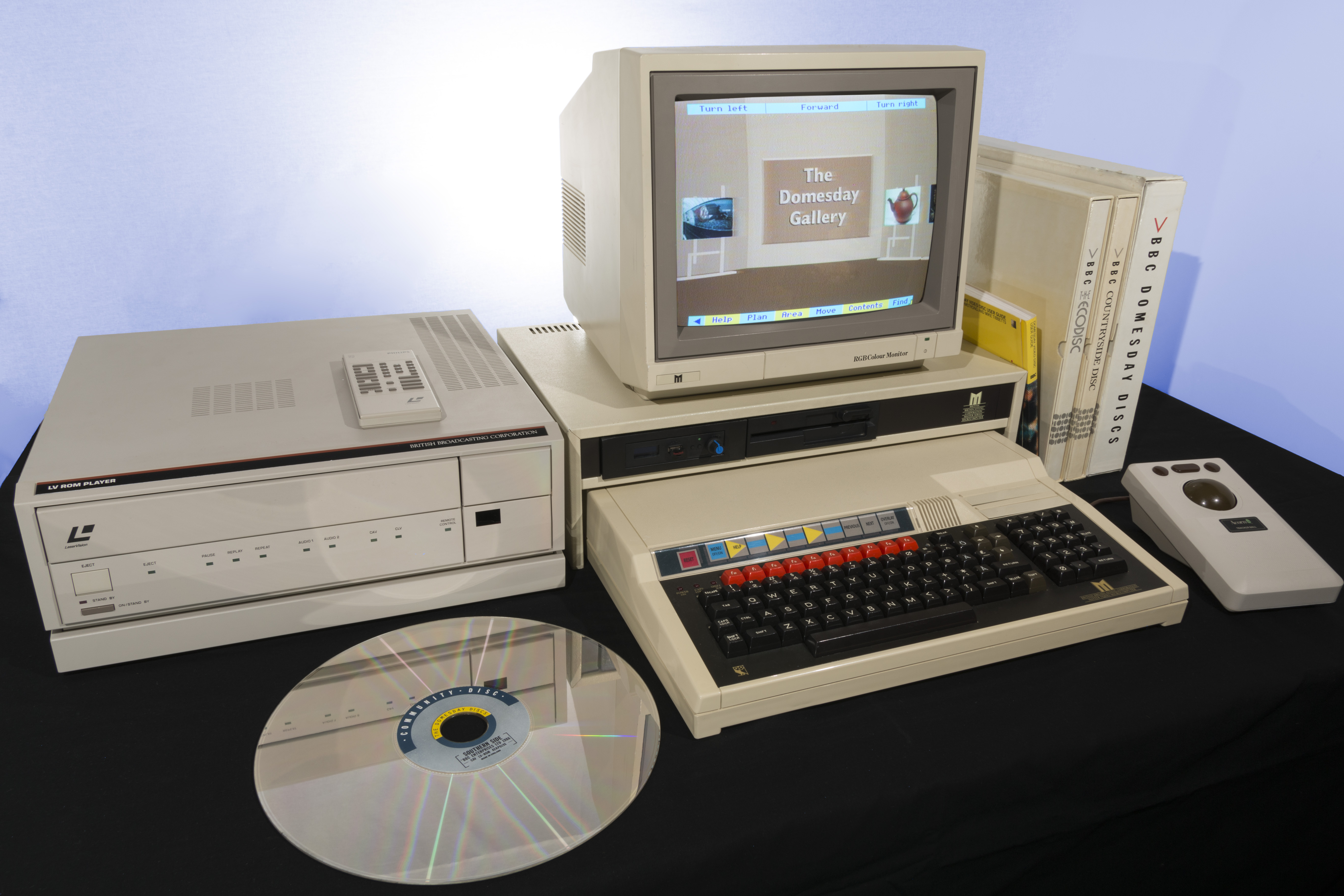
The BBC Domesday Project was an ambitious effort to produce a digital record of the entire of the UK as it was in the 1980s. The project began in 1984 in partnership with Acorn, Logica and Philips. Publication was set for 1986 to coincide with the 900th anniversary of the 1086 Domesday book, which was similarly a written survey of the UK ordered by King William the Conqueror. The original book contained records of the ownership of land and other goods and was used for practical purposes such as tax and defence for hundreds of years. The BBC version was a more reflective account that captured the experiences of individuals. The BBC themselves described it in correspondence as:
"... a contemporary portrait of Britain on interactive videodisc. At the heart of the new Domesday Book will be a 'People's Database' of information generated by local people about their own area."
Domesday was intended as an educational experience in data collection and some 9000 schools were ultimately involved in supplying the raw information. The country was divided into 4x3Km rectangles, a standard used by map makers Ordnance Survey. For the purposes of the project each of these rectangles was known as a "D-Block" (Domesday Block). Each school was allocated an area consisting of one or more D-Blocks. The allocations were usually performed by a local council or other government authority on behalf of the BBC. Often in urban areas multiple schools were present in each block and they further divided them up amongst themselves. Up to three photographs and twenty pages of text could be submitted for each D-Block.
The project hoped to incorporate many images from all over the country, but in 1984 few computer systems could even display a photographic quality image and certainly none had the capacity to store very many even with the assistance of a hard disk which was a rare peripheral at the time. The BBC's solution to this problem was LaserDisc, players for which had been available since the late 1970s.
LaserDisc was a 12 inch optical format often used for movies but unlike the optical formats that followed, the image was not stored digitally but was actually an analogue television signal. If a LaserDisc is carefully examined, the distinctive pattern of the television waveform can be seen on the disc surface.
Domesday used a less common format of LaserDisc called CAV or Constant Angular velocity that had a particular advantage. These days all video players can produce a pin-sharp freeze frame image when paused but in the 1980s this was not the case and the great majority of video players would usually experience jitter when paused producing an unviewable image. The reason a modern video player does not have this problem is a copy of the frame currently being displayed is held in a memory buffer that the video display continuously cycles over. In 1984 memory was very expensive and so was the circuitry necessary to convert video to digital form making this kind of frame buffer impractical for systems intended to be marketed at prices home users could afford.
A CAV LaserDisc solves the lack of memory problem by carefully synchronising the rotation of the disc with the timing requirements of a television such that the disc delivers exactly one video frame per disc revolution. This means that when the disc has finished delivering a frame it is mechanically back in exactly the same disc position as when it started, ready to repeat the same frame over again. With a sharp freeze frame capability, this meant a photograph could be store as a frame of analogue video.
The disadvantage of the CAV format is that it could store only about half the video of the more common alternative type (CLV discs or Constant Linear Velocity). The outer edge of a disc is longer than the inner edge meaning it can store more frames of video. However, if only one frame of video is permitted per rotation then some of the outer edge space is wasted. With a standard LaserDisc already having an inadequate capacity of an hour per side, this presented a significant limitation as it meant a typical movie release would be interrupted at least twice during viewing and two discs or more would need to be pressed as opposed to one. However, for the purposes of Domesday, which intended to mainly store still images (a small amount of video was also included), the lower capacity was not as significant a limitation. In all, it was possible to store about 54,000 images per side of the disc, which was plenty.
Whilst the video was analogue, a digital audio track was available in the format and where there is digital storage, there is the possibility of storing data regardless of what use the track was intended for. Domesday used this feature to store text to accompany the images. It was also used to store the Domesday software. It was possible to store about 324MB of data per side in addition to the images. This digital storage capacity was an order of magnitude greater than any commercial hard disk available at the time. When used in this mode, the discs were known as "LV-ROM".
Acorn chose to use their BBC Micro product for the project. A special version of the BBC Master was produced called the "AIV". This was a BBC Master 128 but with some upgrades. It included a faster processor and also a SCSI card to interface with the LaserDisc player. The BBC Master could not display a true colour photographic image and so would be unable to display the images on the disc. To solve this problem a video mixing feature was incorporated into a Phillips LaserDisc player (model VP415) such that the output from the BBC micro analogue RGB port was overlaid on top of the image output from the player. Where the BBC micro outputted black, this would be transparent and the LaserDisc image would appear underneath.
The VP415 also had another helpful feature not often seen on other players, which was an instant track skip. Typically a LaserDisc player might take a second or more to skip tracks but the VP415 was mechanically fast enough to jump to nearby tracks during the "vertical blank" phase of video signal output. An analogue television signal incorporates a short interval where no video is output between every frame. This is to allow old style CRT televisions time to sweep the electron beam from the bottom of the screen back to the top (modern televisions do not require this). The period when nothing is visible is too fast for the eye to see and the viewer has the impression of a continuous picture. During this period, the VP415 could skip to another track as long as it was not more than 50 tracks away from the current track. This provided the player with the ability to seamlessly transition from one still image to another. The same feature could also be used to do a trick similar to the "multi-angle" feature seen on DVD where the viewer can flip between different camera angles of a playing video.
The instant track skip was exploited by Domesday to add a map scroll feature. The user interface presented a map of the UK and the the user could scroll around to find an area of the country of interest and then zoom in to see the associated data for that region.
Each involved school was sent BBC Micro software to perform data collection for their region (a Research Machines version was also available). The schools returned floppy discs and cassette tapes with their submissions along with 35mm film slides of their photographs. These were collated using a DEC VAX 11/750.
The final Domesday data was presented on a set of two LaserDiscs called the Community Disc and the National Disc, with the majority of information delivered by schools on the former. The National Disc contains formal statistics about the UK including census data and professionally taken photos on one side with a small amount of video of news reports from the 1980s on the other.
Sources of Domesday Content
LaserDisc is of course no longer a current format and the Domesday project has been sometimes cited as an example of digital obsolescence due to the unavailability of the equipment needed to read it. Several attempts have been made to make the data available on the web though.
The easiest method of accessing the content at the time of writing is probably the Computer History Museum Domesday Emulator. This boots an emulated BBC Micro in a web browser and displays the content in the original form. To view the school submissions, use the "Community Disc". The country is split down the middle and you need to select either the North or South of the UK as appropriate for the area you wish to view. It may be helpful to view the demonstration video before attempting the use the system as the user interface is quite different to that which a modern PC user may expect.
The BBC hosted a project called Domesday Reloaded on their website in 2011 which did have the original content (much of which was derived from the original master tapes) but this was taken offline many years ago. Quite a lot of the content was however mirrored onto archive.org. The National Archives holds a copy of the Domesday data from the same source but unfortunately at the time of writing has not done a particularly great job of making it searchable and accessible to the public and it's quite difficult to find anything.
Hobbyists have taken copies of the original Domesday discs and made them available on archive.org. These are recordings of the analogue signal present on the discs and require special software to decode called ld-decode. It is possible to extract all of the data from the discs into modern formats using these tools.
Image Credits: BBC Micro AIV Photo, by simon.inns, Creative Commons Attribution 2.0 Generic