

The Dragon 32
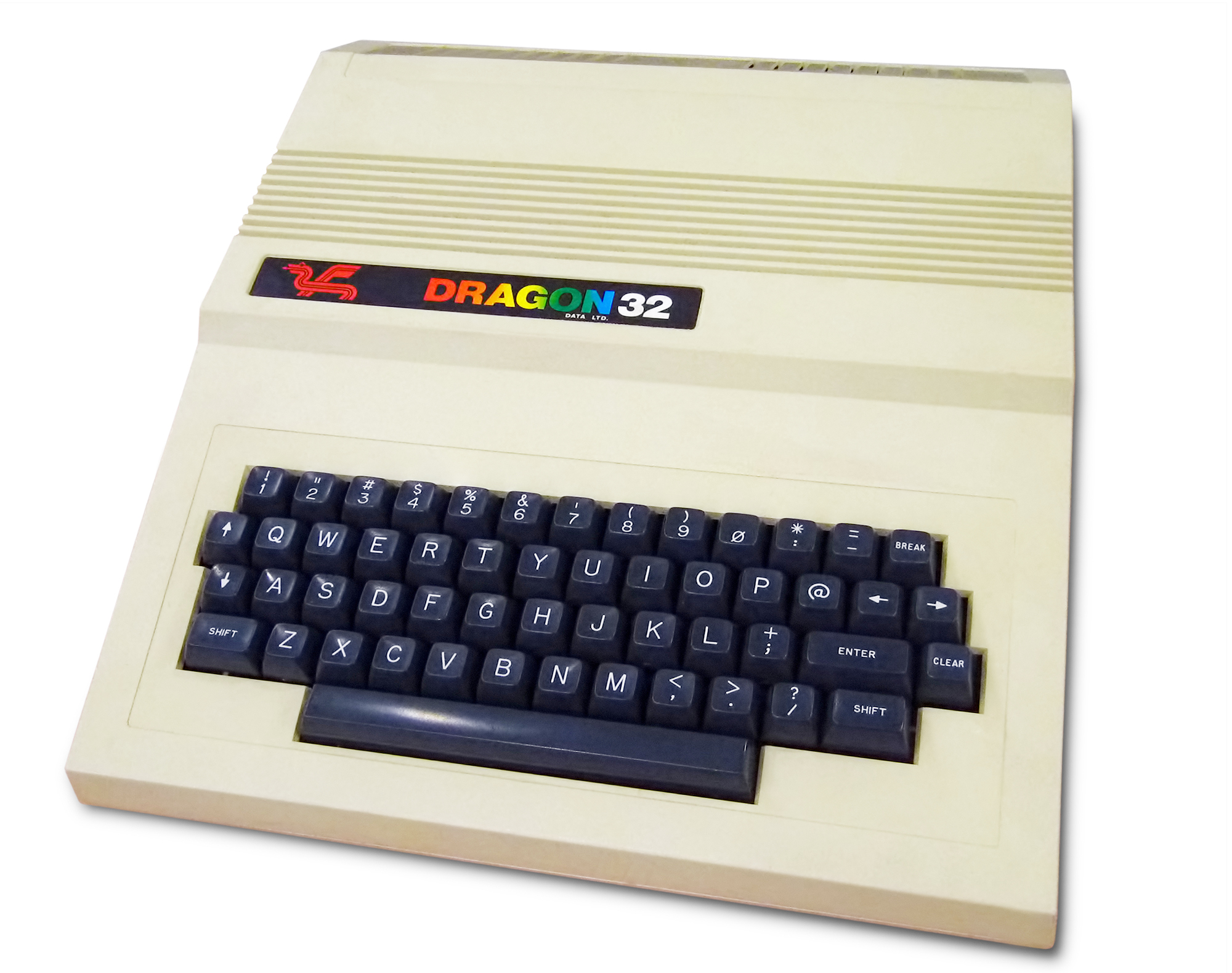
Mettoy were a Welsh manufacturer of toys, best known for their Corgi brand of die-cast metal cars. The company’s financial director, Tony Clarke, had previously been an electrical engineer and in 1980 bought an Apple II out of interest. With his extensive knowledge of toy industry costings, he concluded that the machine could be manufactured at a much lower price point than it was being sold at. This got him thinking about whether Mettoy, with its existing factories and retail distribution channels, might be well positioned to produce a computer.
Clarke recalled that a former colleague, Gerry Quick, had a doctorate in computer science and he was enlisted to help create a specification. Following this, Clarke needed to convince his somewhat less technical fellow board members that a computer could be a winner. This was cleverly achieved by holding a meeting at the Personal Computer World show in 1981. Here the directors of Mettoy saw hundreds of children transfixed by computer screens and it was obvious to everyone that Clarke was onto something. The project received the go-ahead.
Ian Thompson-Bell of Cambridge based consultancy PA Technology was contracted to produce the design. At an early meeting, he brought along a Tandy TRS-80 Colour Computer (nicknamed the CoCo) to show Clarke. He also had with him the data sheet for the Motorola MC6883 Synchronous Address Multiplexer chip, of which one was used in the CoCo. To reduce costs, the chip integrated the functions of several components necessary for a complete computer system into a single device.
The Tandy TRS-80 Colour Computer design has no relationship at all to the 1977 Tandy TRS-80 and is completely incompatible with it. Tandy just recycled the brand name as it was well-known and the previous machine had sold well.
The MC6883 was originally developed by Motorola for a ‘videotex’ project which was an attempt to produce an inexpensive data display terminal for US farmers to receive business information such as commodity prices and weather via modem. Tandy had been contracted by Motorola as the manufacturing partner for the device. The CoCo is similar to the ‘AgVision’ version of the agricultural terminal, also sold under other brands, even down to sharing the same case. The AgVision case has a position for an LED to show the state of the data connection. This is covered over with a marketing badge on the CoCo, which does not contain a modem.
The data sheet for the Motorola part included a ‘reference design’. These were example circuit diagrams often provided by manufacturers to demonstrate how to use their chips. Reference designs were most usually royalty free as every time someone used it for a product, the chip manufacturer sold more components. Thompson-Bell opened up the CoCo and showed that the design of the machine was based closely on the Motorola reference design. There was nothing preventing Mettoy basing their computer on the exact same design too, and Clarke approved it to expedite the process of delivering a product. From this the Dragon 32 was hatched.
Coincidentally there was a UK government subsidised agricultural edition of the Dragon 32 specifically for farm management called ‘FarmFax’, but this was unrelated to the Motorola/Tandy AgVision system and didn’t involve modem communication.
Due to their shared heritage, the Dragon and the Tandy CoCo are indisputably very similar but it isn’t correct to say they are identical as the two machines do have some differences. The Dragon removed the CoCo serial port and replaced it with a parallel interface as that was more suited to the average printer then on sale in the UK. A key difference was the Motorola design was for the American NTSC analogue television system whereas the UK at the time used PAL and for this an adaptation was required. Motorola themselves would provide some assistance in developing this. Microsoft Extended BASIC was also included as standard in the Dragon, which was a more advanced version than was included in the base CoCo model but could be added as an option.
The Dragon and the CoCo were never intended to be software compatible and the ROMs included with the two machines are different. However, since the hardware designs are relatively close, some executables for one machine do by chance work directly on the other without modification. Compatibility in this regard is hit and miss and hinges on exactly which features the software uses, with differences in the keyboard hardware on each machine being a particular source of problems. With the correct ROM and some rewiring though, either machine can be converted into a closely binary compatible version of the other.
The Dragon was based around the 8-bit Motorola 6809E processor as used in the reference design. This was a development of the preceding 6800 and had a number of improvements bringing it in step with the competing MOS 6502 and exceeding it in a number of areas. It included a hardware multiplication unit which the 6502 does not have. It also could internally perform some operations in 16-bit.
The 6809E was, however, about five times more expensive than competing CPUs and ran at only 0.89 MHz in the Dragon, whereas other CPUs usually used higher clock speeds which could provide a degree of compensation. The 6809E could generally easily outperform a 1Mhz 6502, such as used in the Commodore 64, but would meet its match against a 2Mhz version, as used in the BBC Micro.
There was a way to overclock the Dragon to 1.79Mhz with only a software command, which was a feature also present on the CoCo. Many Dragons would crash at the higher speed although a few would work depending on the luck of the components installed.
Despite relatively good performance, a significant practical problem with this CPU choice was that it was simply less common in the market than the Z80 and 6502 used in other micros. This meant it was more time consuming for games companies to port successful products from other platforms and software houses didn’t always bother.
The Dragon was originally specified with 16KB of RAM but right at the last minute, Sinclair brought out the ZX Spectrum with 48KB to be pitched in the same segment of the market. The Dragon 16 very quickly became the Dragon 32 with 32KBs included to get somewhere into the same area as the Spectrum. Early models of the Dragon have the extra 16KB provided on a hastily grafted daughter board that rises precariously on pins above one of the memory chip positions, making clear that this was far from the original design intent.
Graphics were provisioned by the Motorola MC6847 chip which could offer bitmap modes of 128 x 192 graphics in four colours or 256 x 192 in monochrome. The machine had 8 colours (and black) but no bitmap mode could use all the colours at the same time. The four colour mode was switchable between two different palettes of either green, yellow, blue and red or white, cyan, magenta and orange. Curiously, black was not available in the four colour mode. The white colour also wasn’t quite white, it was more manila.
There is a hack that exploits the 256 x 192 monochrome mode to generate four 'artefact' colours with half the horizontal resolution. The palette produced is black, white, blue, and red, which is a much more visually appealing combination than the official colour palettes. The catch is the trick only works with the American NTSC analogue television system and not with the PAL system used in the UK. Many US CoCo games would use this unofficial mode due to the improved colour choices it offered and consequently many CoCo games that might have worked on the Dragon only appear in monochrome.
The video chip supported another graphics mechanism known as ‘semigraphics’ where the programmer could combine alphanumeric characters with pre-defined tiles of pixels producing an effect somewhat like character graphics, although the actual hardware implementation used a different approach. In some variations of this technique all 8 distinct colours and black could be used. There were several semigraphics modes, the most frequently used of which offered a 64x32 grid of tiles. The main limitations were that each tile could only be one colour other than black and only a specific set of hard-coded patterns of pixels were possible within each tile. It was not possible to define arbitrary custom pixel patterns in tiles.
The system didn’t include a sound chip but could produce audio in software using two different methods. The first was ‘1-bit’ sound where a single MC6821 PIA pin was connected to the audio output. By rapidly toggling the pin on and off in software, a square wave could easily be generated. Using more sophisticated software, it was possible to produce other tones by way of pulse-width modulation.
The Dragon also included a 6-bit resolution DAC which was for use in generating sound via wavetable sampled audio. This was at the time an unusual feature to be built in by design and programmers of other machines often had to resort to exploiting hardware bugs and quirks to achieve this effect. However, the memory and computational limits of the machine left sampled audio as an occasional novelty as opposed to a routinely used feature. The DAC is also used to provide a reference voltage for a comparator circuit to determine the analogue joystick position. This made it challenging, though possible, to deliver clean audio if the joysticks were in use simultaneously.
The Dragon was released in August 1982 and got off to a roaring start. Having originally estimated only 10,000 units would ever ship, by the close of 1982 Mettoy had sold in excess of 30,000. There were conflicting reports about product availability with some suggestion of shortages and other suggestions that demand was being met. Unlike many of their contemporaries, Mettoy were well used to high volume manufacturing practices and had entirely their own facilities. They were probably better equipped than most to keep up with demand.
Unrelated to the briskly selling Dragon, Mettoy’s overall financial position had deteriorated though and the company was losing money. In November of 1982, the machine was spun out into a separate division, as Dragon Data, and sold to an investment group that included Prudential Insurance and the Welsh Development Agency. The new ownership would in the short term have a positive benefit for the product and Dragon were full of ideas for the future.
There was a new larger factory near Port Talbot. Plans emerged for a disc unit and a 64KB upgrade. A new advanced operating system from Microware Systems Corporation called OS-9 was announced, which had already appeared on the CoCo.[4] This included multi-tasking and multi-user features with a spreadsheet, database and compilers. It would give the Dragon a professional edge and be aimed at the education market.
OS-9 appeared on many platforms and would be the operating system for the short-lived Phillips CD-i console. The O/S retains a small niche even today in embedded systems.
The Dragon 64 would see a release, but it would first go on sale in the US from a partner called “Tano”. Unfortunately it didn’t make much of an impact there and neither would it in the UK when it would subsequently appear. It wasn’t enough of an upgrade from the Dragon 32, of which sales had slowed, and there also wasn’t a great deal of software that could take advantage of the extra memory. Dragon Data would reach the end by 1984. A Spanish company called Eurohard SA briefly stepped in with plans to make the Dragon the premier educational machine in Spain but this did not come to pass.
Image Credits: Dragon 32, by Bill Bertram, Creative Commons Attribution-Share Alike 2.0 Generic license