

The ZX Spectrum Story
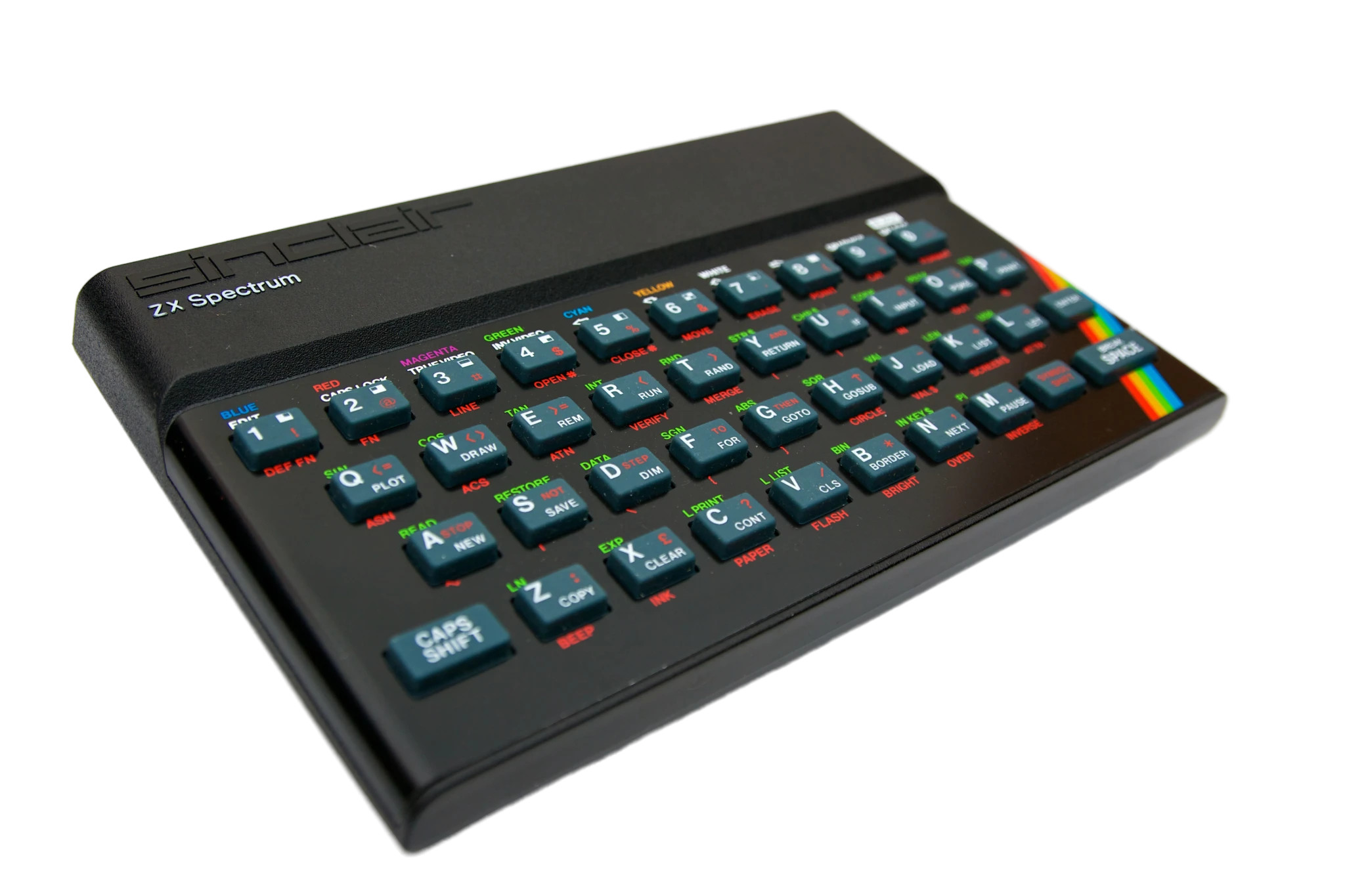
It seemed as though Sinclair was unstoppable. The MK14 had been a good success, the ZX80 did even better but then the ZX81 came along and knocked it out of the park with massive sales. Given these numbers, a ZX82 was a foregone conclusion and with this machine sales wouldn’t end up anywhere near the park at all, they would be launched into space.
Clive Sinclair himself had many technological interests, of which computers played only a small part. There was what was certain to be the electric transport of the future just waiting to be invented, and a miniature TV was in the works. As Sir Clive was mainly busying himself with his myriad of other creations, the new computer project would be left in the safe hands of the talented and proven Richard Altwasser.
Sinclair developed a highly innovative flat screen CRT technology, considerably thinner than the more conventional cube shaped monitors of the time. Apple seriously considered it for the display of the original Macintosh, in the end selecting a conventional CRT due only to concerns about Sinclair’s capability to manufacture it in sufficient quantity. Apple’s concerns were well founded as Sinclair also considered it for their own QL machine but didn’t think they could solve the manufacturing difficulties in time. Had it been produced early enough, Sinclair may have enjoyed a near monopoly in portable computer displays for a few years until LCDs, which were poor quality at the time, reached an acceptable standard.
When the ZX81 had been released, no one had any idea at all what uses the great British public might find for a computer, but now at least there was some limited information. The government’s computer literacy endeavour was in full swing, with many users educating themselves in the art of programming. That had to be a core feature of any new machine, but also there seemed to be a distinct drift towards an interest in entertainment software emerging.
The ZX Spectrum was never designed explicitly as a purely games machine. It wasn’t at the time proven conclusively that games would ever be a significant market in the UK, and some saw monochrome graphics as all that a computer could ever require. However, experience derived from the previous Sinclair machines suggested games were on the rise, with many popular titles appearing despite the extreme limitations of the platform. Altwasser didn’t receive a clear strategic plan as such from his distracted boss, but more a vague nod in the gaming direction by implication. He was instructed to take the ZX81, improve the graphics, add colour, and just one more thing … keep it nice and cheap.
Altwasser got to work, developing the system using the comically sparse design resources available. It was alleged Clive Sinclair claimed a ZX81 could run a nuclear power station, although this may be more of an urban legend and a cartoon of the sort of marketing hyperbole he might have come out with. What was certain, though, was that a Sinclair machine was of little assistance in the emerging field of computer-aided design. The Spectrum circuit layout was performed using black sticky tape stuck to a light box, with a notepad for calculations.
The Spectrum was originally envisaged as a 16KB computer, like a fully expanded ZX81, and to be priced at £125. However, it was later decided that a more expensive version with a then-substantial memory upgrade to 48K would also be made available for £175. In the latter model Sinclair did something clever to bring down the cost of the expensive components.
It was found that partially failed memory chips could be purchased at a much-reduced rate. The base model of the Spectrum contained a conventional, fully functional 16KB of RAM. However, in the more expensive model, the additional 32KB of RAM was actually achieved using partly broken 64KB chips. Faulty memory chips were tested by the manufacturer and marked as to which regions of the chip were non-functional. At least half of the memory would be operational. Sinclair received these and sorted them into batches. Chips where the same regions of the address space were working would be grouped together and used within a single computer as an additional 32KB, bringing the machine up to 48KB in total. On the Spectrum circuit board, there is a selector, set with a wire link at manufacturing time, that informs the computer which regions of the RAM are working and which parts should be avoided.
The Spectrum would use the Z80, which was the same CPU as the ZX81 employed. It would receive a fractionally faster clock rate of 3.5MHz. The Z80 could have achieved 4MHz but the 3.5Mhz choice was derived from half the 7Mhz clock used for the PAL video circuit timings and this avoided requiring two separate oscillators as halving a clock only requires a simple circuit.
Compared to the 3.25MHz speed of the previous model, there wasn't much difference in clock speed, but the overall performance of the Spectrum would be very considerably better. The ZX81 requisitioned the lion’s share of the CPU time for rendering the video display, leaving not much left for the user’s program. This issue would be eliminated on the Spectrum, and the machine would receive a proper hardware video circuit that didn’t involve the CPU to the same extent, only vying with it when contending for access to the memory. Competitors were solving this with one, or sometimes several, custom video chips, but that was too expensive an option for a cost sensitive Sinclair machine. Instead, a custom solution was developed, again making use of a Ferranti ULA to reduce the chip count.
Only the lower 16KB contends with the video circuit, so game developers would often place the most time-sensitive code into the upper 32KB by preference to achieve better performance.
The Spectrum offered a resolution of 256x192 pixels which derived from the specification of the ZX81 and was quite reasonable for the time, but a major improvement over the predecessor was that it was now officially bitmapped. Whilst on the ZX81 clever programmers had managed to work out exotic techniques to achieve a bitmapped display or else additional hardware could be used, the Spectrum now supported the feature natively without fuss. This ensured games could be written more easily.
The requirement to add colour though proved problematic. At 256x192 pixels, if 16 colours were offered then 4 bits of colour information would be needed per pixel. This would mean 24KB of RAM would be needed to store the display in a bitmapped fashion. With a 16KB version of the machine to be on sale, this memory allocation wouldn’t be possible. The RAM requirement for the display had to get a long way under 16KB to leave a plausible amount of memory free for user programs.
In the end Altwasser settled on no more than 7KB to be consumed for the display in order to still leave a reasonable 9K for software use. A total of 6KB would be needed for a black and white bitmap, leaving the colour information to somehow fit within a meagre 1KB. This was achieved by only allowing two colours to be set per block of 8x8 pixels, as opposed to the colour of each pixel being individually addressable. One colour is the ‘foreground’ colour, which is selected when any pixel in the 8x8 block is in the 1 state and the other colour is the ‘background’ colour, which is selected when any pixel in the block is in the 0 state. This mechanism was inspired by teletext graphics, but the technical implementation is quite different and Altwasser would receive a patent for it.
Each 8x8 block is allocated one colour ‘attribute’ byte, bringing the total colour memory requirement well below 1KB. Three bits set one of eight colours for the foreground and three bits were used for the background. If a 7th bit in the byte is set, it modifies the two colours to make them brighter. This unusual choice was an artefact of simplifying the circuitry in the ULA to bring the gate count down, as the electronics needed to achieve the extra brightness effect are much simpler than adding extra hues. In addition to video, the same ULA would need to perform a variety of other jobs, including clock generation, memory arbitration, keyboard control, providing the cassette interface, and sound output, which had to be fitted in somewhere.
There is a debate as to whether the Spectrum actually has eight colours or fifteen, given that it only has eight hues. Are the brightness changes actually additional colours? Going by modern interpretations, they probably are, as brightness variations are included in computer colour counts although number of colours is now rarely mentioned in computer marketing as it has reached the point where there are plenty enough. However, don’t get started on the 8th bit in the Spectrum colour attribute byte as that causes the colours to flash, which most definitely isn’t an additional colour, notwithstanding Acorn’s insistence that it was in their marketing. Even Sinclair balked at claiming that.
The missing sixteenth colour arises because one of the available colours is black and the concept of ‘bright black’ doesn’t make sense.
The Spectrum’s memory-constrained implementation produced a trade-off which came to be known as ‘colour clash’. When a game character straddled colour blocks, it would end up being rendered half in the colour choices of one block and half in the colour choices of the next. If the attribute choices of each block differed, then the game character would gradually change colour as it moved from one block to another. This was particularly problematic when two differently coloured game characters were close together on the screen, as it wasn’t possible to resolve the clash between the two, and one or other would end up in the wrong colours.
Unexpectedly, the more expensive 48KB version of the Spectrum would end up being the best seller by a mile, and the 16KB version was quickly dropped. Of the few who did buy the cheaper edition, many would choose to upgrade it with the additional RAM to the extent that the machine is rarely remembered as being ever anything other than a 48KB system. If the Spectrum had been designed from the outset as a purely 48KB machine, then colour clash probably wouldn’t have happened as the design wouldn’t have been so memory-constrained. While at the time colour clash may have been seen as a disadvantage, especially when superior competitors emerged, today it is part of the charm of the system. Game developers did get increasingly proficient at masking the problem, and the quality of titles didn’t really suffer too much for it.
If colour clash is one defining characteristic of the Spectrum then another is certainly the rubbery keyboard. This was constructed somewhat like the typical keypad found on a television remote control. From a modern perspective, this would be looked upon as poor quality but in the context of the time, it was a step up from the ZX81 membrane keyboard, providing at least positive tactile feedback for key presses. The improvement would be praised in contemporary magazine reviews. In practice, though, a full day of typing on the Spectrum was not a realistic proposition and professional software developers with cash to burn would routinely choose other, better equipped machines, such as the Tatung Einstein, as a development platform.
Steve Vickers of Nine Tiles was again drafted in to develop an extended Spectrum BASIC which included many enhancements over the ZX81 version, leaning also on the work of John Grant, who would work on other aspects of the firmware. The previous idiosyncratic method of typing commands was retained, where a single keypress would print an entire BASIC keyword, but due to new features, more complex sequences of keypresses were needed. This method of entering programs was now on the edge of practicality and part of the original reasoning behind it, to save ROM space, was starting to make less sense as device sizes increased.
The Spectrum ROMs were originally intended to contain drivers to be used with anticipated peripherals. However, development of the add-on devices was not completed before Spectrum production was due to begin. It would turn out there wasn’t much spare space left over anyway in the 16KB chip. Consequently, the peripherals ended up incorporating additional ROM devices containing the missing code, and the Spectrum used a hastily developed and slightly hacky mechanism to swap them in when required.
The centrepiece of the peripheral offerings was the ZX Microdrive, which was demonstrated at the launch of the Spectrum and appeared, to all intents and purposes, a fully finished product. A tiny storage device was presented on a table, but, like a deftly executed magic trick, there was a bundle of unseen prototype electronics hidden underneath and in reality it was far from complete. Sinclair said nothing about how it worked, and much of the assembled media interpreted it as an incredibly cheap disk drive, to be available for the astonishingly low price of £49.95. Sinclair did little to dispel the helpful rumour that built excitement, but it was in fact a form of cartridge tape unit.
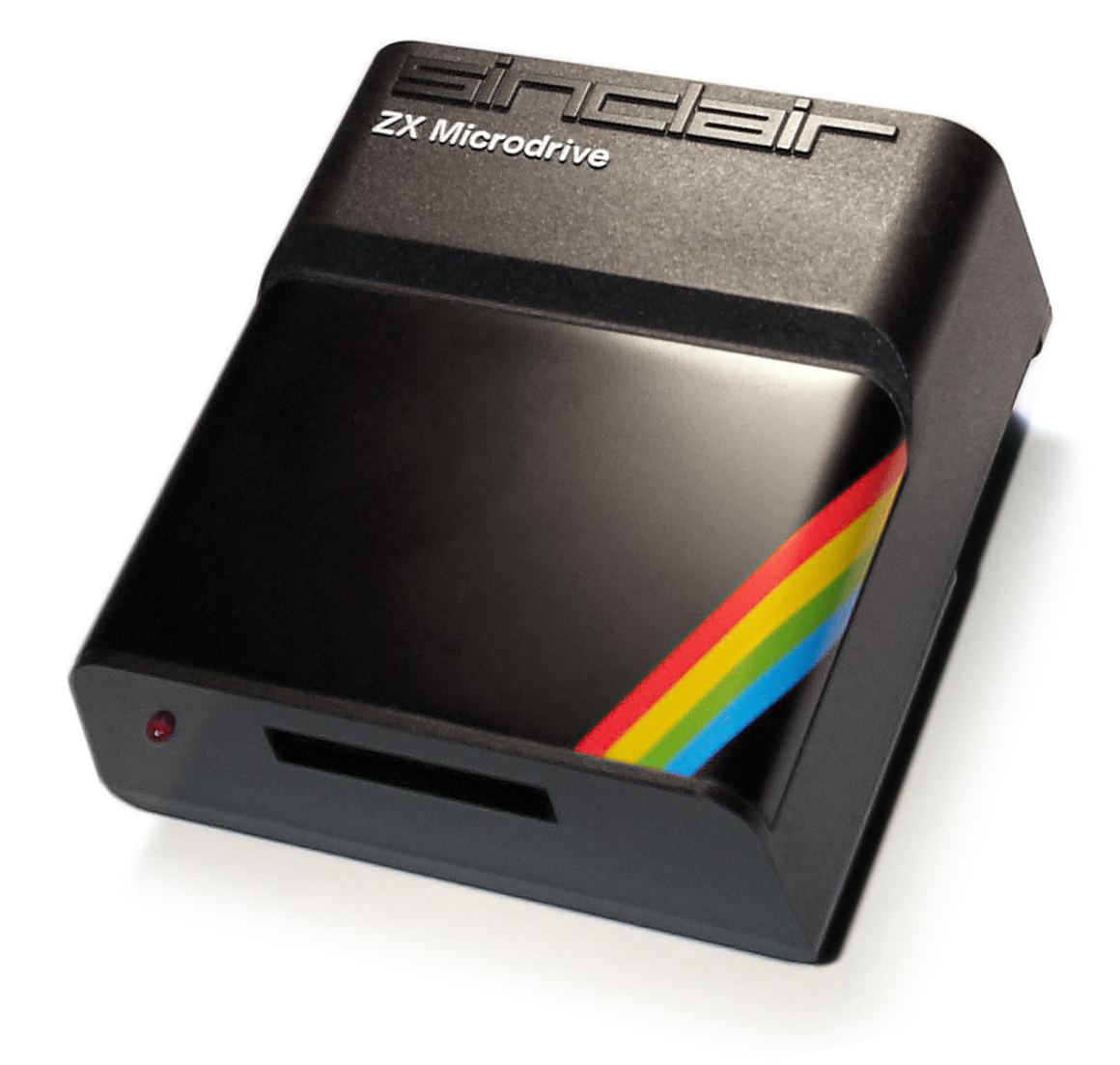
Cartridges for the system contained a five-metre-long continuous loop tape storing 85KB and could transfer data at a rate of up to 15KB/s. It could completely fill the Spectrum’s memory in 3 - 4 seconds and offered a seek time of no more than 8 seconds. The Microdrive was an immeasurable improvement over audio tape, which would take many minutes to achieve the same. For activities such as loading games, it could even beat a typical floppy disk (and completely thrash the notoriously slow Commodore 64 disk unit) and all at an order of magnitude lower cost.
On paper, the Microdrive was the presumed future king of low-end storage and was well within the budget of the Spectrum’s target market. Unfortunately, it was initially beset with reliability problems. Tapes in the first versions of the system would become stretched just beyond the capability of the electronics to read them, resulting in Sinclair’s credibility being stretched even further. The effective price of the drives increased due to the necessity to buy an additional interface to make use of it, and the cartridges were more expensive than a typical floppy disk. When combined with the standard practice Sinclair production delays, the system never took off, and the vast majority of Spectrum users would stick with conventional audio tape. Issues with reliability were later largely resolved, proving the technology could have been practical, but by then it was beyond the point when it could usefully compete against price-reduced floppy drives.
Launched in April 1982 with Clive Sinclair’s trademark showmanship, the Spectrum was an instant critical and commercial success. However, as with his previous machines, Sinclair struggled to satisfy the surge in demand. Initially restricted to mail-order, early adopters faced gruelling three-month wait times; by September, even with production hitting 5,000 units a week, the backlog remained a staggering 40,000 orders. It took until 1983 for supply to finally stabilise, eventually paving the way for the original Spectrum to ship over 3.5 million units.
Extensive software support followed, cementing the Spectrum as the UK’s primary gaming platform. Beyond high-street staples like Dixons and WH Smith, the machine’s reach extended even to the local newsagent, where rotating wire racks of cassette tapes became a ubiquitous sight. This accessibility fueled a massive library; while at least 10,000 commercial titles were produced, the total catalogue likely exceeds 30,000 when accounting for homebrew projects, public domain software, and magazine listings. To this day, the Spectrum remains one of the most well-supported gaming platforms in history.
Much to Clive Sinclair’s chagrin, the Spectrum failed to gain a foothold in education with his protégé, Chris Curry, having already sewn up the market. Despite getting the machine onto the government-approved list for schools, few actually bit. However, the Spectrum did leave an indelible mark on the nation's digital literacy through more informal means. Its affordable price point helped democratise computing; for the first time, young enthusiasts could own a machine of their own. Where the ZX81 provided an inexpensive platform to dabble and discover if computing might be a good fit, the Spectrum delivered genuine capability to the masses. By fostering the rise of the bedroom coder, the Spectrum arguably did as much for the British IT industry as the formal curriculum.
The Spectrum was hardly out of the gate when, in August of 1982, Nick Searle, managing director of Sinclair Research, was teasing the press with a new mysterious ZX83. This would be a professional machine, light years ahead of the Spectrum - some may even call it a quantum leap. Even so, the humble Spectrum still had plenty of life left.
The Spectrum+ would be released in 1984, gaining an improved, although not yet quite perfect keyboard, but was otherwise the original 48K model. Then, in 1985, came the Spectrum 128, which offered a number of real technical enhancements. This version was nicknamed the ‘Toastrack’ due to the inclusion of a large, finned heat sink down the right-hand side. The UK had not yet bought sufficient Spectrum+ units for Sinclair’s liking, and the company was still sitting on unsold stock when the new machine was ready. Consequently, British buyers would be punished with release delayed until the following year. However, tax changes in Spain provided the imperative to release it immediately in that market. As the name implied, the 128 contained 128K of RAM. This was beyond the addressing capability of the Z80 CPU, so the extra memory was bank-switched in. To protect the local Spanish market, machines with 64K of memory or less were subject to a new import duty; however, the 128 was exempt from this rule.
Sound was much improved by the inclusion of a General Instrument AY-3-8912 chip, widely used in other machines. An RS232 interface was now standard. It also had an RGB port to attach a proper monitor. There was an enhanced ROM and BASIC that now no longer required the ‘one keypress per command’ method of entering programs, instead, commands were typed more conventionally, one character at a time.
The Spectrum now also featured a ‘MIDI port’ - sort of. It was more of a suggestion to the user that the RS232 port could be converted into MIDI Out using an appropriate circuit and cable. This enabled the machine to be used as a sequencer for new music equipment that was now emerging. The required circuit was not particularly complicated, needing only a few inexpensive passive components. Whilst Sinclair was notoriously frugal, a few extra pennies here would have significantly expanded the use case for the machine beyond gaming. Instead, the Atari ST, released at around the same time, included a proper standards-compliant MIDI implementation that worked out-of-the-box and captured the market.
Despite huge computer sales, Sinclair was in financial trouble. Sales of his other inventions had not been great, and development costs were very high. Most notably, it had turned out the C5 was not the transport of the future. Sinclair had seen an untapped market for a small vehicle for short local trips. It didn’t need a licence, insurance or tax and could be driven by children or the elderly. At the right price, those without a car might see the advantage. However, the implementation had a few too many problems for the public. It sat too low in the road for other drivers to see it and had no structural safety protection. Battery technology wasn’t yet sufficiently advanced. It had limited range and couldn’t handle hills effectively, requiring the rider to pedal. It was completely open, offering no protection from the great British weather, a situation not aided by Sinclair’s decision to release it to the press during the somewhat inclement month of January.
The C5 problems would be compounded by the miniature TV not doing as well as expected and the quantum leap failing to leap far enough. All of these problems weighed too heavily against the massive success of the Spectrum. By 1986, Sinclair would run out of road and an investor was needed. Several prospects looked at Sinclair’s desperate financial position and declined, but one investor couldn’t have been more keen.
Alan Sugar of Amstrad was well-versed in the consumer electronics business with many products, including the CPC 464 computer, on sale, which was partially inspired by Sinclair’s success. Sugar could see past the balance sheet and realised how a deal could be structured. He had an idea to apply the Amstrad magic to the Spectrum with a new package offering, but he would need to act fast if he was to get anything ready in time for the important Christmas market. Before any paperwork was signed, or he had even met Sinclair, Sugar had an Amstrad Spectrum model designed and made a large investment in manufacturing tooling.
The Spectrum +2 would be essentially the 128, but with a better keyboard and an attached, pre-configured tape recorder that made set-up less finicky. It was in effect Spectrum electronics, productised like the successful CPC and delivered at a new lower price, courtesy of Amstrad’s more refined manufacturing and distribution expertise. After a comical, last-minute scramble involving chasing down a canal boat, where John Grant, who held the rights to the Spectrum ROMs, had gone on holiday, the deal would go through and the +2 would see production.
Sugar could have easily let the Spectrum sink, leaving more room for his existing and well-respected CPC; however, with a massive Sinclair games back-catalogue, perhaps there were more sales to be had with both combined. There was also the strong brand to consider. Whilst in no way hidden and well-known to the trade press, Amstrad kept their involvement with the machine relatively muted in marketing. The Sinclair brand remained prominent, and only a minor mention was made of Amstrad in the Spectrum’s documentation. Sugar’s approach proved a winning strategy, and Amstrad went on to add around two million more units to the Spectrum total.
Where Sinclair was culturally an innovation-led company, Amstrad was more about sales and hard numbers. In this respect Sugar may have neglected a major asset bundled in with the Sinclair acquisition: an extraordinarily talented electronics research team. Ideas were brewing for a new, advanced games machine known internally as ‘Loki’, but Amstrad showed little interest. It may have been that development costs would have been high and Amstrad were not themselves a bottomless pit of money, but whatever the reason, the Spectrum technology would only be modestly upgraded from this point forward, and Amstrad would view the machine mainly as a cash cow. In lockstep with the CPC, it did acquire a disk drive and an associated operating system with the +3 released in 1987, but that would be the end of the line… officially.
There was also a Sinclair ‘Janus’ system, for which a prototype white and black vertically mounted case existed with just the slightest resemblance to the Sony Playstation 5. There is little information as to the intended specification although it may have been some kind of games console as it has no keyboard. Perhaps something to do with the Loki?
On the other side of the Iron Curtain was the mysterious Soviet Union and those of us in the West heard very little about what went on there. Sanctions impacted some types of Western computer exports, but while many home computers may have been exempt, the import side of the equation was not entirely straightforward either.
Foreign technology was not prohibited as such in the Soviet Union, but discovery at borders might result, at best, in some additional discretionary ‘taxes’, and at worst, difficult questions about the ideological fitness of the importer. Despite the risks, Spectrums had started to find their way into the Eastern Bloc through the small numbers of travellers who were lucky enough to obtain exit visas to West Germany or elsewhere in addition to somehow coming up with the requisite currency.
The diminutive dimensions of the original Sinclair machine, easily slipped inside a jacket, had proved to be ideal for smuggling past border guards. By contrast, one can imagine the risks inherent in attempting to bypass the Stasi with an Amstrad CPC down your trousers. Even so, only the privileged few would ever have access to an official machine; yet, as it turned out, there was another way for Eastern Europeans to experience the corrupting Western decadence of Jet Set Willy.
In the Eastern Bloc, the economics of electronics production worked somewhat differently to the West, and the Spectrum would prove to be the perfect computer for another reason. When cut off from Western distribution channels, computer production was not primarily driven by the latest parts or the lowest production costs, but more by what was obtainable locally. The Zilog Z80 had been cloned early on in East Germany, with several manufacturers elsewhere in the bloc producing other versions, and that was one tick in the box for the Spectrum.
The Kombinat Mikroelektronik Erfurt U880 was an East German Z80 cloned in around 1980. Zilog had attempted to obscure the design with deliberately confusing elements to slow down the cloners, but this was eventually figured out.
The ULA was not obtainable, but it fell into a sweet spot: it was simple enough to reverse engineer with modest equipment, possible to recreate using only locally available components, and yet complex enough to offer interesting capabilities. Jurij Dobush of Ukraine figured out the internal function of the chip through the examination of a borrowed Spectrum with an oscilloscope. He was able to acquire circuit diagrams for the machine from East German students, and knowledge was exchanged with colleagues in Lithuania, who were also interested in cloning the Spectrum. Disassemblies of the ROMs had apparently been published in a West German magazine; once obtained, these were typed in by hand. The end result was the Lvov 48K, released in 1985. The Ukrainian and Lithuanian versions would form two separate branches that would together be the ancestors of most of the clones.
The early Eastern Bloc Spectrums perhaps needed up to 60 local chips, depending on what was available, as opposed to 26 in the more highly integrated official Sinclair machine. However, later cost optimisations such as the Leningrad-1 by Sergey Zonov, released in 1988, got the clones more into the region of a little over 40 chips. The Leningrad did not have perfect Sinclair compatibility, and some Spectrum software didn’t work due to slight differences in hardware timings, but the vast majority of software was compatible. Later clones would achieve near-flawless cycle accurate compatibility, emulating all the Spectrum’s quirks, with virtually all software working.
Spectrum clones proliferated like wildfire courtesy of at least 50 different manufacturers and continued to do so long past the commercial lifespan of the machine in the West. The level of integration gradually improved and the machines became cheaper. While the Spectrum sold at least 5.5 million units under Sinclair and later Amstrad, unofficially it may have sold greater than a million more in the East. The true statistics will never be known, as many were built by small enterprises with no records available, but the widespread cultural memory of the machines and relative ease with which they are surfaced by retro enthusiasts suggests there were vast numbers of them in the wild.
In a similar way to how the PC cloners eventually outgrew IBM, even as Sinclair went under and Amstrad lost interest, Spectrum development continued in Eastern Europe. As time moved on, several clones improved the specification considerably. There were double-speed 7Mhz Z80s, megabytes of bank-switched RAM, higher resolution video modes up to 640x200 with colour clash eliminated, sound cards, expansion slots and more.
Back in the UK, the Spectrum hadn’t been forgotten by everyone. Alan Miles and Bruce Gordon, both formerly of Sinclair Research, had been producing disk systems for the Spectrum through the second half of the 80s. They used the profits from the venture to finance development of a new computer project under their company, Miles Gordon Technology. The new system would have a 6MHz Z80, 256KB of RAM (upgradable to 512KB) and offer a maximum of 512x192 resolution graphics with up to 16 colours from a palette of 128. Much improved audio was delivered via an eight-channel Philips SAA1099 sound chip.
Developed from 1986 and released in 1989, the machine would be known as the ‘SAM Coupé’, with SAM allegedly standing for ‘Some Amazing Machine’. The system had a novel case design that somewhat resembled a sports car from the side, which was the origin of the ‘coupé’ part of the name. Four blue feet looked like wheels against a white wedge shape reminiscent of an angular performance vehicle. Up to two 3.5” disk drives could slide into the case at the front; perhaps these were the headlights.
Whilst the SAM Coupé was a different architecture, it included excellent emulation of the 48K Spectrum with accurate hardware timings. Given also the links between the original developers and Sinclair, the machine is often considered a successor to the Spectrum and a credible example of what may have been had Sinclair continued independently of Amstrad.
As is a common theme with computer releases, it was unfortunately perhaps a fraction too late. The Commodore Amiga Batman pack emerged at almost exactly the same time, featuring an A500 bundled with popular software. A new, lower price combined with a tie-in game of high production values for a hit movie proved to be a massive success and overshadowed the SAM Coupé. With UK buyers now thinking about 16-bit as the upgrade of the future, another Z80 machine wasn’t the advance the market was looking for, and the system only achieved modest sales. Had it been released a year earlier, it might have had more impact.
Life would be quiet in the world of the ZX Spectrum for a couple of decades, but once the machine was old enough to be retro, it would be back with a vengeance. Several hardware recreations emerged with the ability to run on modern TVs. Much as the SAM Coupé had tried to do, some projects, such as the ZX Spectrum Next, reimagined the system with new features, following an evolutionary path from the original hardware. In addition to compatibility with the original Spectrum, the Next offers a 28MHz Z80, up to 2MB of RAM and 256 colours from a palette of 512, also adding 128 hardware sprites, which was a feature missing in the original design. The Next was a success with the enthusiast community, and more revisions followed alongside other recreations from different groups.
The Spectrum brought computing into millions of homes, kickstarting countless careers and companies. Even today, the platform continues to thrive, sustained by a vibrant community producing new, modern hardware and hundreds of fresh games. The humble Spectrum has undoubtedly secured a lasting legacy in the history of technology.
Image Credits: Sinclair ZX Spectrum, by Nico Kaiser, Creative Commons Attribution 2.0 Generic; ZX MicroDrive, by Scott Telford/Letdorf, Creative Commons Attribution 2.5 Generic