

The Oric-1 Home Computer
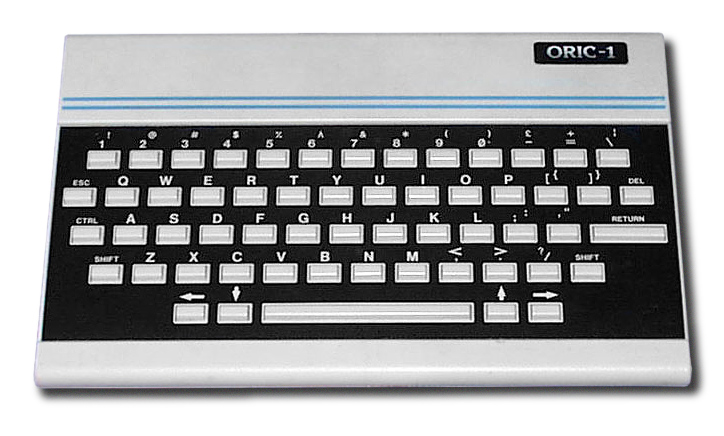
The Oric-1 was a UK 8-bit microcomputer released in January 1983 and aimed squarely at competing with the ZX Spectrum market. While several use cases were advanced, the primary intent was that it would be used as a low-cost gaming platform for the home. The machine was designed by Tangerine, who had previously released the Microtan 65, but under contract from a separate company due to the preferences of an investor. Priced at either £129 or £169 depending on the model, it was competitive with the Spectrum in both cost and specification when originally released. It achieved respectable sales with over 200,000 units shipped, although never displaced its more popular rival.
There was a rumour of the day that the Oric was named after "Orac" which was a fictional computer that featured in a 1978 episode of the popular sci-fi TV series Blake's 7, but this is a myth. The name was actually derived more mundanely from a partial anagram of the word "micro" but without the M.
A large proportion of Oric sales were in France, with the machine at one point holding a majority market share of all computers sold in the country. The French company A.S.N. had been searching for a computer to market locally. Lamenting the state of the French computer industry at the time, they had turned to overseas suppliers and the Oric impressed them the most. An exclusive deal was signed for French distribution in June of 1983.
The success in France was assisted by the fortuitous inclusion of an RGB video interface as standard. A viable home computer in the early 1980s needed to be able to connect to a domestic television as monitors were very expensive. France used it's own SECAM television system which while adopted in some other countries none were particularly prolific technology exporters and most computers were not compatible with the standard. However, the great majority of French televisions were additionally equipped with an RGB input, the inclusion of which had been government mandated by 1980. The Oric was fully compatible, requiring only an inexpensive cable. The inclusion of RGB was more of an accident as the Oric designer, Paul Johnson, had some spare logic gates left over on completing the design and decided to use them for that purpose rather than let them go to waste.
Specifications
The Oric was based around the MOS 6502A running at 1Mhz, a common choice of CPU. Even though the Z80 based ZX Spectrum it competed against ran at 3.5Mhz, the Oric would have been broadly comparable in performance (or possibly slightly faster) as the 6502 was internally much more efficient in its use of clock cycles.
The Oric originally shipped with a choice of 16KB or 48KB of RAM. The latter option actually had 64KB physically installed but in a highly unusual design choice given the expense of RAM at the time, the top 16KB was by default unused due to the layout of the memory map where the address space was occupied by the ROM. Even more unusually, no mention of the fact the machine contained a third again more RAM was made in marketing materials at a time when home computers were sold on how much memory they contained. Only a brief mention of the extra 16K is made in passing in the manual and it can only be accessed when a specific pin (ROMDIS) is asserted on the expansion connector. The purpose seems to have been to reserve the memory for system usage by connected peripherals, although with the design primarily aimed at games and the quality of games being somewhat memory constrained, this may have been an extravagence.
Video was delivered by a custom chip built on a ULA platform. Two video modes were available, a character mode with 40x28 characters and a bitmap mode of 240x200 pixels in 8 colours. As was a fairly common compromise in contemporary machines, the colour of each pixel was not individually addressable, although the Oric had a much finer degree of colour resolution than the Spectrum with two colours being available per 6 adjacent pixels on each row compared with the 8x8 colour blocks of the Spectrum. It was therefore less afflicted by the "attribute clash" effect although this still ocurred to some degree.
Audio was a particular competency of the Oric and it could produce significantly better sound than the Spectrum. It used a three channel (plus noise) General Instrument AY-3-8912 which was widely deployed in arcade games and very similar sound chips would subsequently be used in a number of other popular and more advanced home computers including the Atari ST. The machine also included a particularly large internal speaker, which further enhanced the sound quality.
The machine had a centronics style printer port and Oric released a colour printer, the MCP-40 which was similar to a Tandy CGP-115 and based on an Alps design. Colour printers were not common at the time and a monochrome dot matrix would be more typical of a printer encountered by a home user. The device was actually more of a plotter with four different coloured pens and while it did work well for graphics it was less suited to business letters. The Oric could also be connected to more conventional printers.
As was standard for home computers of the era, the Oric was equipped with a generic expansion connector attached to the system bus and also a cassette interface. A 3.5" floppy drive would appear by 1984.
Inexpensive keyboards were a problem for a low-cost home computer in the early 1980s as the cheap commodity keyboards we now enjoy were not available. Tangerine's solution was a "chiclet" style keyboard consisting of thin rectangular keycaps. It delivered a better tactile typing experience than the ZX Spectrum's rubber keys although was still far from ideal and much better quality competitors existed. With the positioning of the machine as a purely games computer with few aspirations in other markets, this probably wasn't a major issue though.
Prestel
The Oric's text mode was intended to be compatible with the Post Office (later British Telecom) Prestel system. This was an information service offered via modem in the UK that resembled Teletext but with two-way interactivity as opposed to being passively consumed on a television. Tangerine had some history in developing Prestel terminals under the Tandata brand, which may explain their particular interest in the feature.
It is notable that a passing resemblence can be observed between some Tandata Prestel terminals and the Oric, with a similar type of keyboard and arrangement of ports on the rear. There may have been some design influence although there is no clear direct lineage from one product to the other and they were positioned in separate companies.
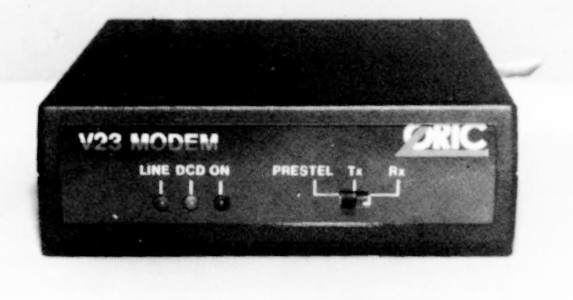
A modem was promised at launch for the Oric but not delivered until well into 1984 when the Oric line was into its second iteration. This was a model TM2 designed by OE Limited of Penrith and came bundled with Prestel software (note also the mention of Prestel on the front panel). Tangerine suggested in their own magazine that they would take out many pages on Prestel for the benefit of Oric users but there is no comprehensive archive of pages from the period to confirm if this was ever done.
The French had their own highly successful Prestel equivalent called Minitel and enterprising Oric-1 users did figure out how to connect their systems to the service. The final version of the Oric, the Telestrat, would be specifically intended for connection to Minitel.
Later Models
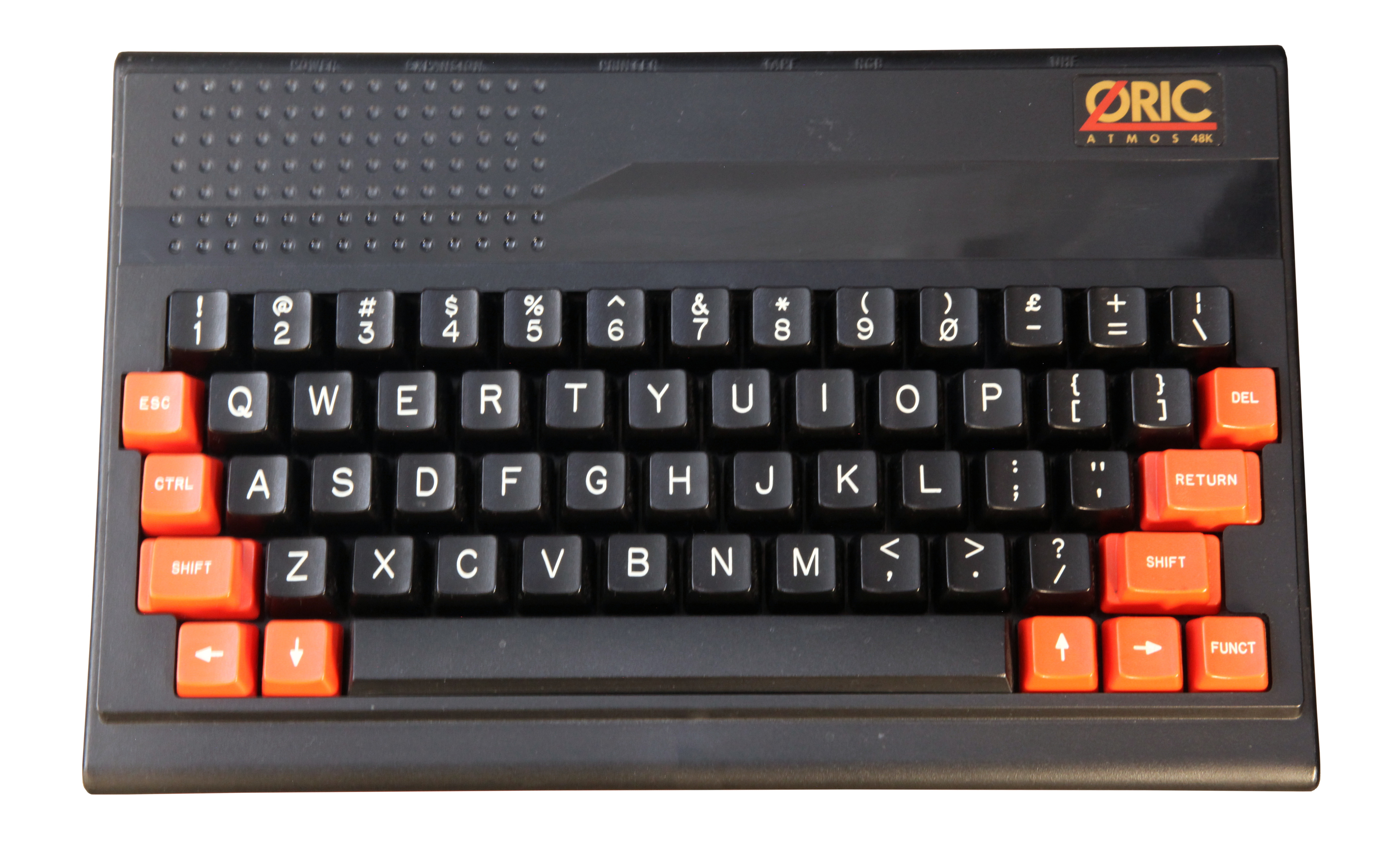
In 1984 the Oric Atmos was released, which included a much improved mechanical keyboard and a slightly upgraded ROM but was otherwise the same machine as the Oric-1. The Atmos regularly featured as a background prop in the popular IT Crowd TV series.
The final Oric model was the Telestrat, released in France only, which added a cartidge port and communications features.
A licensed version of the Oric was sold in Yugoslavia under the brand "Nova 64". This was an identical design to the Oric Atmos but the branding noted that it did in fact have 64K of RAM.
An unlicensed clone also appeared called the Pravetz 8D which was sold in Eastern Europe until 1991, well past the market lifespan of the Oric in the West. This was largely a copy of the Oric but with a mechanical keyboard and a modified ROM that could display cyrillic characters.
Image Credits: Oric-1 Photo, by CarbonCaribou, Creative Commons Attribution-Share Alike 3.0 Unported; Oric Atmos Photo, by Rama, Creative Commons Attribution-ShareAlike 3.0 France